
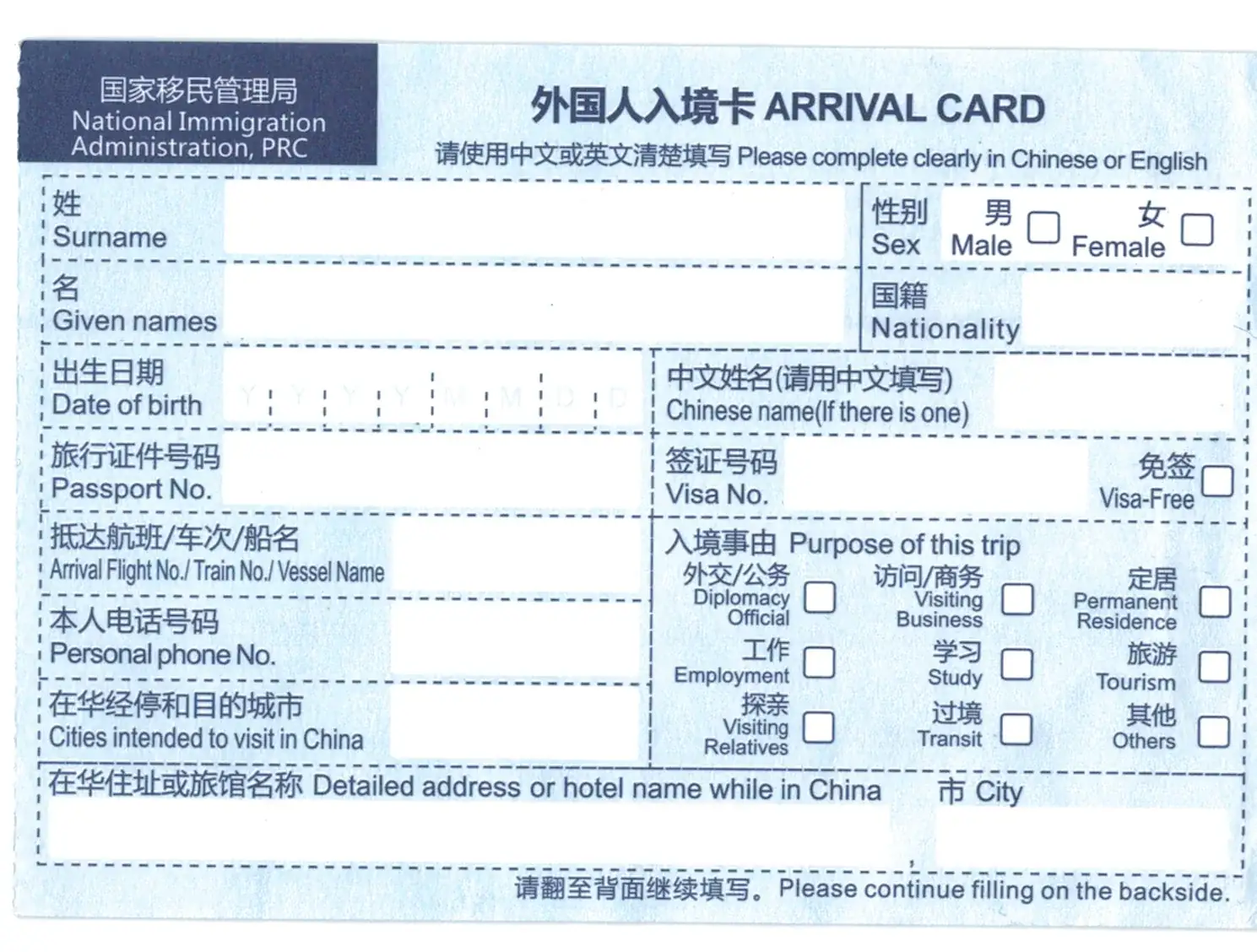
The China Arrival Card (外国人入境卡) is a short form every foreign visitor fills in before passport control unless they are on the exemption list. Since 20 November 2025 you can fill it in online for free on the National Immigration Administration (NIA) site at s.nia.gov.cn, in its NIA 12367 app or in WeChat/Alipay mini programs, and show the QR receipt at the border. Paper cards are still available at every port. This guide walks through the official form screen by screen, as it looked when we tested it on 23 October 2026, explains the paper card, and covers the questions travellers crossing by car from Hong Kong or Macau ask us most. If you are booking a Hong Kong to Shenzhen private car transfer or a Macau to Zhuhai private car, you can fill in the card the evening before and cross with nothing to write at the border.
The China Arrival Card in 30 seconds
| Question | Answer (as of 23 October 2026) |
|---|---|
| Who fills it in | Foreign nationals entering mainland China, unless exempt (see below) |
| Cost | Free. Any site that charges is not the official one |
| Where | s.nia.gov.cn (computer or phone), NIA 12367 app, WeChat or Alipay mini programs, the QR code at the port, or a paper card |
| How early | NIA says “before coming to China”; the form’s calendar accepted dates up to 3 months ahead in our test |
| What you get | A receipt with one QR code per person, as a PDF download or by email |
| Languages | 13, including English, Russian, French, Spanish, Arabic, Japanese, Korean, Thai and Vietnamese |
| Changing it later | No edit button: submit a new card with the right details |
| By car from Hong Kong or Macau | Transport mode “Automobile”; the flight number box can stay blank |
What the arrival card is, and what changed in November 2025
The card itself is not new. NIA’s visitor brochure Welcome to China says all foreigners must fill in an arrival card and sign it before immigration clearance, and that the “Intended address in China” must be accurate: a hotel address, not just a city.
What changed is how you fill it in. On 3 November 2025 NIA announced ten new measures, one of which lets foreigners submit the arrival card online before they travel. It took effect at all ports on 20 November 2025. Online filling is an extra channel, not a new obligation: if you could not do it in advance, you can complete it at the port by scanning a QR code with your phone, using the self-service devices there, or writing a paper card.
The online system has been popular. NIA reposted a Legal Daily report in May 2026 saying 15.55 million foreign entries had been declared online in about half a year, and that paper filling used to take five to eight minutes per person in Beijing. One person can now file for travel companions too, which the same report describes as “one person fills in, several people share”.
Before November 2025 some airports ran their own local versions. Chongqing Jiangbei Airport, for example, launched an online pre-fill in January 2025 that printed the card at the airport.
Who must fill it in, and who is exempt
The card is for foreign nationals. Hong Kong and Macau residents who are Chinese citizens enter with the Home Return Permit (Mainland Travel Permit for Hong Kong and Macao Residents) and do not use this card.
As of 23 October 2026, the instructions page of the official online form lists eight groups who do not need to fill it in:
- Holders of a valid PRC Foreign Permanent Resident ID Card.
- Holders of a valid Mainland Travel Permit for Hong Kong and Macao Residents (Non-Chinese). Since July 2024 this permit has been available to non-Chinese permanent residents of Hong Kong and Macau.
- Foreigners in 24-hour direct transit who do not leave the port’s restricted area.
- Members of foreign tourist groups entering visa-free as a group or on a group visa.
- Foreign crew members, drivers and other employees of transport vehicles.
- Cruise passengers who enter and leave on the same ship.
- People eligible for the courtesy treatment of centralised submission of entry and exit documents (VIP clearance).
- Foreigners entering through the E-channel (fast-track e-gates, for those registered). For example, eligible foreign residents can use the e-gates at Hengqin, and at the HZMB Zhuhai-Macao Port since 26 January 2026.
NIA’s November 2025 announcement and the embassy notices list seven groups; the live form adds the seventh item above and names drivers explicitly in item 5.
Note what is not on the list: travellers on 30-day visa-free entry and on 240-hour visa-free transit. The form’s own instructions say transit travellers who leave the port within 24 or 240 hours can fill it in, so plan to file a card if you use either policy.
The four ways to fill it in
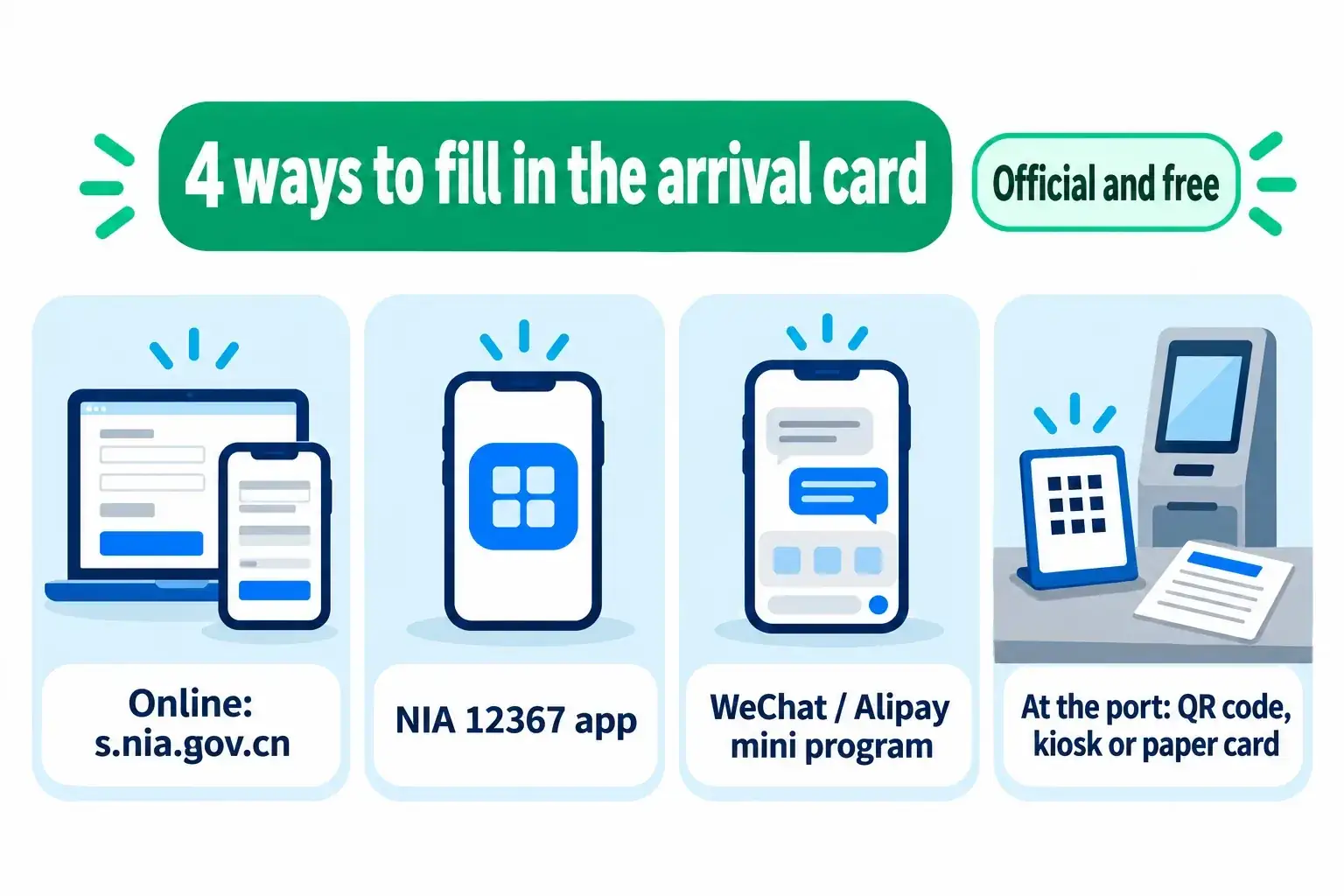
- Online at s.nia.gov.cn. The computer version is at s.nia.gov.cn/ArrivalCardFillingPC. On a phone the site opens a mobile version with the same steps and a “care mode” with larger text.
- The NIA 12367 app (移民局12367).
- WeChat or Alipay mini programs, both named 移民局12367.
- At the port. Scan the arrival-card QR code posted in the immigration hall, use the self-service devices, or fill in a paper card.
All four are free. For help, the China Immigration Service hotline is 12367 (from abroad, +86-10-12367).
Step by step: the official online form
We went through the whole form on 23 October 2026 with test data, in English and Chinese, without submitting it. The labels below are copied from the form. An asterisk (*) means the field is required.
Before you start
- Language. Use the “Language” switch at the top right. The form offers 13 languages: Chinese, English, Russian, French, Spanish, Arabic, Japanese, Korean, Lao, Mongolian, Burmese, Thai and Vietnamese.
- Entry Declaration. The home page has two buttons: “Entry Declaration” (for most travellers) and “Entry Declaration for Border Area Residents” (only for border-resident certificate holders from seven neighbouring countries).
- Instructions. Read the exemption list, then tap “I AGREE”.
- Have ready: your passport, a clear photo of its data page, your hotel or home address in China, a phone number, and your travel date and port.
Step 1: Uploading ID Document Page
| Field (English / 中文) | Options and notes |
|---|---|
| * Type of ID Document / 证件类型 | Diplomatic Passport, Service Passport, Passport for Public Affairs, Ordinary Passport, Seaman’s Book. Most travellers pick Ordinary Passport |
| * Upload ID Document Page / 上传证件资料页 | A JPG or PNG photo of the passport data page, taken as in the sample diagram |
The system reads the photo and fills in your name, passport number, nationality and date of birth. Check every auto-filled character; the form itself warns that the data comes from the photo and should be changed with care. If it cannot read the photo, you type the details in yourself.
Step 2: Basic Information Filling
| Field | Options and notes |
|---|---|
| * Last Name / 英文姓 | As in the passport |
| First Name / 英文名 | Optional (for people with one name) |
| * Gender / 性别 | Male, Female |
| * Date of Birth / 出生日期 | Year, Month, Day dropdowns (Year and Month required, Day optional) |
| * Country/Region of Citizenship / 国家/地区 | Shown with the three-letter code, e.g. United Kingdom (GBR) |
| * Type of ID Document, * Passport Number | Carried over from step 1 |
| * Entry Transportation Mode / 入境交通方式 | Vessel, Flight, Train, Automobile, On Foot, Automobile and On Foot |
| Arrival Flight/Train/Vessel Number / 入境航班/车次/船次 | Required only when you choose Flight. Optional for every other mode |
| * City of Entry / 入境城市 | A picker with popular cities (Shenzhen, Zhuhai, Guangzhou, Beijing, Shanghai…) and a province list |
| * Port of Entry / 入境口岸 | The list depends on the city and transport mode you chose |
Choose the transport mode before the city: changing the mode later clears the city and port. If you enter a flight number, the system tries to fill in the city and port for you.
Step 3: Personal Information Filling
| Field | Options and notes |
|---|---|
| Chinese Name / 中文姓名 | Optional |
| * Country/Region of Birth / 出生国家/地区 | Plus an optional city of birth |
| * Contact Number / 联系电话 | Free text; include your country code |
| Email / 电子邮箱 | Optional, but useful if you want the receipt by email |
| * Do you hold a valid visa or other entry permit? | Yes or No |
| * Visa Number / 签证号码 | Appears if you answer Yes |
| * Entry Policy Selection / 入境政策选择 | Appears if you answer No |
The Entry Policy Selection list changes with your nationality, port and passport. The options we saw were Visa-free Entry, 24-hour Temporary Entry for Transit, 240-hour Temporary Entry for Transit and Emergency Temporary Entry Permit. If none fits, the form says “You don’t qualify for visa-free entry”, which usually means you need a visa. A link under the field opens NIA’s pages on visa-free transit, the unilateral visa-free country list and regional visa-free entry.
Choosing 240-hour transit adds three fields: Other Name, Other Countries/Regions of Citizenship, and a required “Passport ever lost/stolen” (Yes/No).
Step 4: Travel Information Filling
| Field | Options and notes |
|---|---|
| * Purpose of Entry / 入境事由 | Conference/Business, Visit, Sightseeing/Leisure, Visiting Friends/Relatives, Work, Study, Permanent Residence, Return to Country of Residence, Others, Service (Employee), Diplomacy/official, Transit |
| * Date of Entry / 入境日期 | In our test the calendar allowed today up to three months ahead |
| * Destination Cities in China / 在华目的城市 | The city where you will stay longest |
| Cities of Transit in China / 在华经停城市 | Optional; add more with “+” |
| * Address in China / 在华住址 | Province, city and district, then the detailed address (street and number or hotel) |
| * Do you have any inviting entities or inviters in China? | Yes opens the entity’s or person’s name and contact details |
| * Confirmed Departure Itinerary | Yes opens optional departure date, transport mode, number, city and port |
On the 240-hour transit path the departure itinerary is not optional: departure date, transport mode, number, city and port all become required, because the policy depends on an onward ticket.
Step 5: Accompanying Person(s) Filling
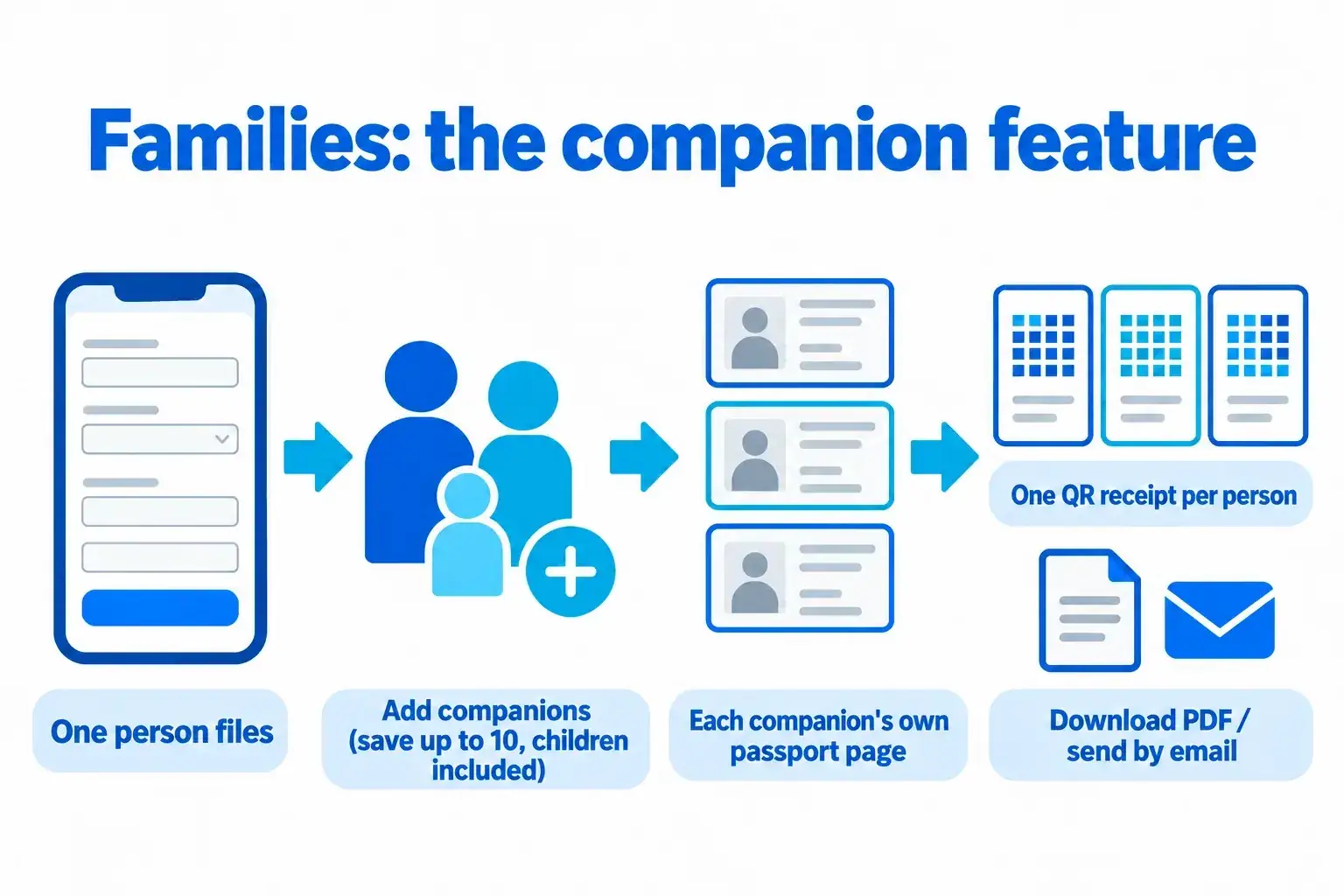
After step 4 the form asks “Need to help your companion fill the form?”. If you say yes, use New to add each companion. Each one needs:
- their own passport photo page and passport number;
- name, nationality, gender and date of birth;
- country of birth and a contact number;
- their relationship to you: Spouse, Parents, Children, Relatives or Others.
Companions share your travel details, so you do not retype the trip for each person. You can keep up to 10 frequently used companions. Children are added the same way, with the relationship “Children”; there is no separate rule for minors on the form.
Declaration, signature and receipt
When you tap Submit, a box shows the declaration: “I understand that China’s immigration authority may lawfully store and use the information provided in this form. I hereby declare that the statement above is true and accurate, and otherwise I will bear the corresponding legal responsibilities.” You tick “I have read and agree to the above statements” and sign with your finger in the signature area.
The receipt is titled “Entry Declaration Receipt for Foreigner” and shows a QR code for each person, with the passport number, name, country, city of entry, port of entry, date of entry and submission date. You can Download to Local (a PDF) or Send to Email. Keep it on your phone, and a screenshot as backup, to show at immigration.
Things the form does not do
- No edit or withdraw button. If your plans change, submit a new card with the correct details and keep the newest receipt. A Nanjing newspaper reported that records from the past year can be reused on a later trip; NIA has not published this rule.
- No fee step. If a site asks for payment, close it.
- No minimum lead time. You can file the night before.
The paper arrival card, field by field
Paper cards are still handed out at ports, and NIA says they remain available. The current card is light blue and headed “外国人入境卡 ARRIVAL CARD”, with the line “Please complete clearly in Chinese or English”.
| Front (as printed) | Tip |
|---|---|
| Surname / Given names | Exactly as in the passport |
| Sex: Male / Female | Tick one |
| Nationality | Full country name |
| Date of birth | YYYYMMDD boxes |
| Chinese name (If there is one) | Leave blank if none |
| Passport No. | |
| Visa No. or Visa-Free box | Tick Visa-Free if you enter under a visa-free policy |
| Arrival Flight No./Train No./Vessel Name | Write the flight, train or ship you arrive on |
| Purpose of this trip | Diplomacy Official, Visiting Business, Permanent Residence, Employment, Study, Tourism, Visiting Relatives, Transit, Others |
| Personal phone No. | |
| Cities intended to visit in China | |
| Detailed address or hotel name while in China, City | A specific hotel or street address |
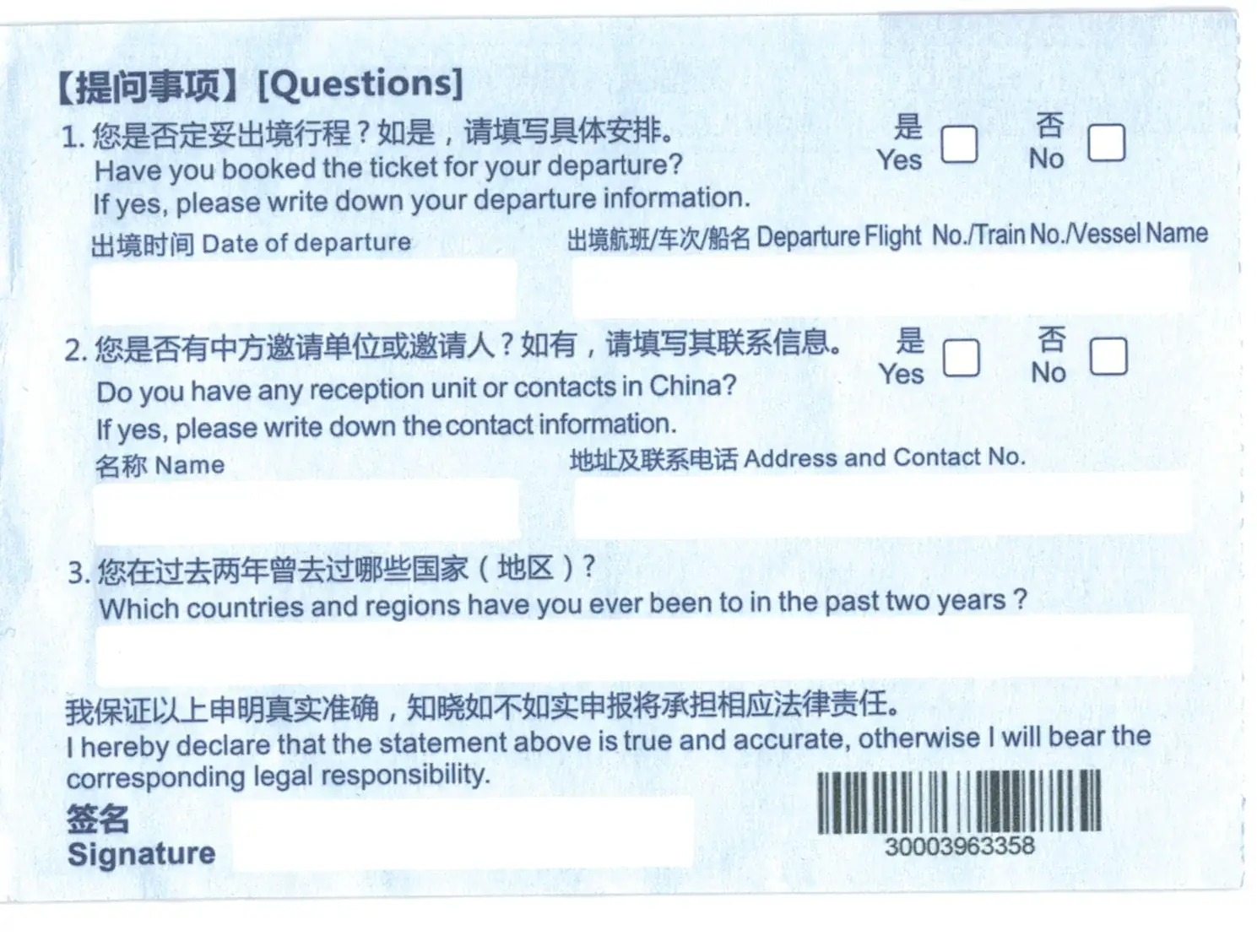
The back has three questions: “Have you booked the ticket for your departure?” (with date and flight/train/vessel), “Do you have any reception unit or contacts in China?” (name, address and phone), and “Which countries and regions have you ever been to in the past two years?”. It ends with the declaration and a Signature line. The paper card has no box for the port or for car travel.
Crossing by car from Hong Kong or Macau
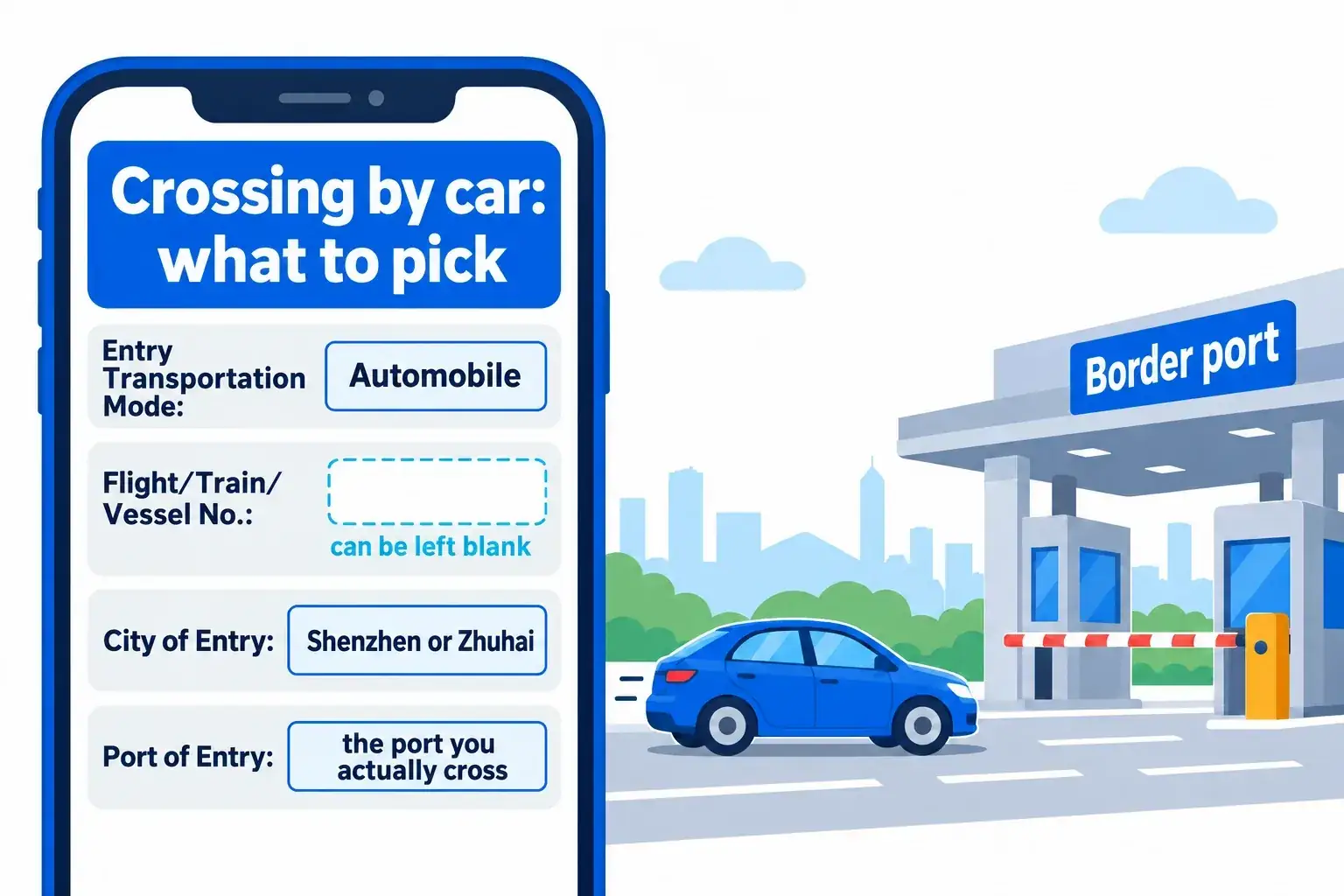
Most online guides assume you fly in. If you cross a land border in a cross-border car, these are the choices that matter on the official form (as of 23 October 2026):
- Entry Transportation Mode: Automobile. If you will also walk through a passenger hall, “Automobile and On Foot” is offered too; both show the same port list, so either works.
- Arrival Flight/Train/Vessel Number: leave it blank. It is only required for Flight.
- City of Entry and Port of Entry. Pick the city and the port you will actually cross at.
| Crossing | City of Entry | Port of Entry (as named in the form) |
|---|---|---|
| Shenzhen Bay | Shenzhen | Shenzhen Bay |
| New Huanggang Port | Shenzhen | Huanggang |
| Heung Yuen Wai / Liantang | Shenzhen | Liantang |
| Hong Kong-Zhuhai-Macao Bridge (from Hong Kong or Macau) | Zhuhai | Hong Kong-Zhuhai-Macao Bridge |
| Macau Barrier Gate | Zhuhai | Gongbei |
| Macau to Hengqin | Zhuhai | Hengqin |
The Shenzhen list also includes Luohu, Futian, Wenjindu and the West Kowloon high-speed rail station (the form lists it under Shenzhen although the station is in Hong Kong); the Zhuhai list also has Qingmao. If you are not sure which crossing your driver will use, ask when you book. At Liantang, Shenzhen News Network reported in October 2026 that border staff help foreign travellers complete the card in the entry hall. When you book with us we confirm the crossing in advance, and you can see the options in our guide to crossing into China by car and on the Shenzhen Bay and Hong Kong-Zhuhai-Macao Bridge port pages.
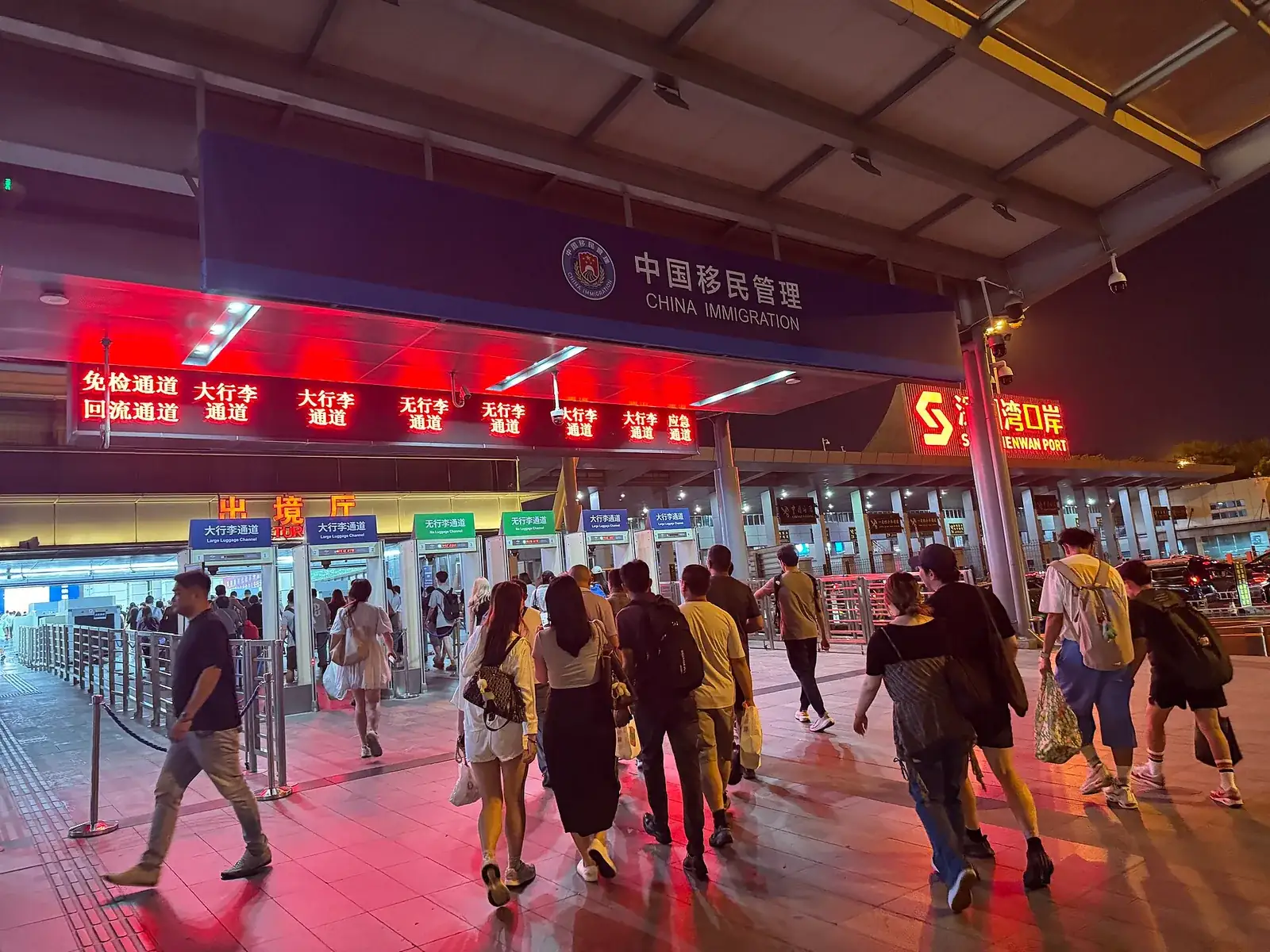
How the crossing works by car. On the Hong Kong side, officers usually check documents in the vehicle lane while you stay seated. On the mainland side, Shenzhen Bay and the HZMB Zhuhai Port ask passengers of cross-boundary cars to walk through the passenger hall, and at the new Huanggang Port passengers generally get out and clear in the passenger hall too; the driver takes the car across and meets you at the exit. That hall is where you show your passport and the arrival card QR code, so have both ready before you reach the port. Arrangements on the day prevail. Travelling with older relatives or small children? See crossing to Shenzhen with elderly parents and kids.
30-day visa-free vs 240-hour transit: pick the right port
The arrival card asks for your entry policy, so it helps to know which one you are using.
30-day unilateral visa-free entry. As of 23 October 2026, ordinary passport holders from the countries on China’s unilateral visa-free list, including most EU countries, Switzerland, Norway, Australia, New Zealand, Japan and South Korea, can enter for up to 30 days for business, tourism, visiting family or friends, exchanges or transit. The list runs until 31 December 2026. The UK and Canada were added from 17 February 2026. The United States is not on the list.
240-hour visa-free transit. Citizens of 57 countries (Kyrgyzstan and Vietnam were added on 20 August 2026) can stay up to 240 hours if they hold a confirmed onward ticket to a third country or region, entering through one of 65 listed ports. Entering through a Guangdong port, you can travel anywhere in Guangdong province.
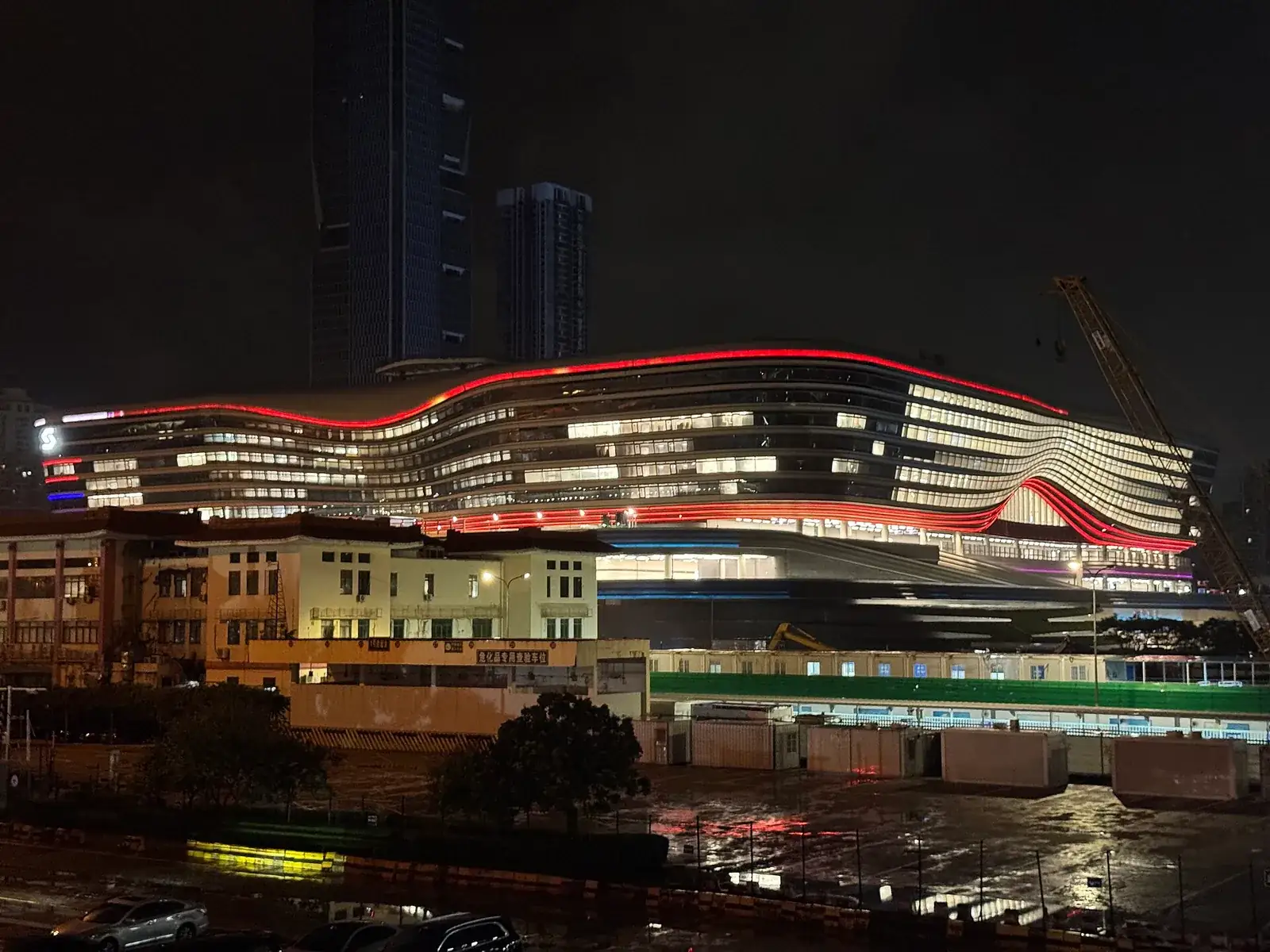
The warning most travellers miss: Luohu, Shenzhen Bay, Huanggang, Futian, Liantang and Gongbei are not 240-hour transit ports. In NIA’s 65-port list, the Guangdong ports are:
- Guangzhou Baiyun, Shenzhen Bao’an and Jieyang Chaoshan airports;
- Nansha and Shekou passenger ports, Guangzhou Pazhou ferry terminal and Zhongshan Port;
- Hengqin Port, the Hong Kong-Zhuhai-Macao Bridge Zhuhai Port and West Kowloon Station.
The online form agrees: when we tested British, German, Australian, Japanese and US passports, “240-hour Temporary Entry for Transit” appeared only for HZMB, Hengqin, West Kowloon and Shenzhen Airport among the ports we checked, and not for the Shenzhen land crossings or Gongbei. If you rely on 240-hour transit and travel by car, enter via the bridge or Hengqin and tell us when you book. Your onward ticket must be to a third country or region, so a round trip back to Hong Kong or Macau, where you started, generally does not count; check with 12367 if unsure. For the full document checklist, see what to carry when crossing by car.
Common mistakes
- Using a copycat site. Search results include paid look-alikes. NIA’s own address is s.nia.gov.cn.
- Writing only a city as your address. NIA asks for the specific hotel or street address.
- Trusting the auto-fill blindly. Compare every letter and number with your passport.
- Choosing Flight by habit. Then the flight number becomes required and the port list shows airports. Car travellers choose Automobile.
- Changing transport mode last. It clears the city and port, so re-check them before moving on.
- Expecting 240-hour transit at Shenzhen Bay or Huanggang. It is not offered there.
- Forgetting the children. Each child needs their own card, added as a companion or filed separately.
- No copy of the receipt. Download the PDF or email it to yourself, in case your phone has no signal at the border.
Scam warning: the official card is free
In December 2025 NIA warned that criminals abroad had set up fake arrival-card websites to collect fees. NIA said online filling is “free of charge”, and that travellers should use only the official website, the government service platform, the NIA 12367 app, the WeChat or Alipay mini programs, or the official QR code.
Want help? We can prepare it for you
If you would rather not work out the form yourself, CROSSBAY can prepare your arrival card answers and check them:
- Free for every traveller on a CROSSBAY car booking.
- US$10 per person for everyone else (children included).
To be clear: the official arrival card is free. The US$10 is our service fee for preparing and checking it for you. We use only the official NIA platform, never a third-party site.
How it works
- Send us on WhatsApp a photo of each traveller’s passport data page and your trip details: date, crossing, address in China, phone number.
- We check which entry policy fits your nationality and crossing. For example, we flag it if your plan relies on 240-hour transit through a port that does not offer it. The final decision on entry is always the border officer’s.
- We prepare every answer in the order the official form asks for them and send you a summary to check.
- The form ends with a personal declaration and a finger-drawn signature, and the declaration is yours. So the last step is done by you: you open the official form (or the WeChat or Alipay mini program) on your phone and enter the answers we have prepared, and we answer questions on WhatsApp as you go. With companions, one adult can submit for the whole group using the official companion feature, and makes the declaration for that submission.
- You download the QR receipt as a PDF or send it to your email, and you are ready for the border.
We use your passport details only to prepare your card and delete them as soon as your card is done. Message us on WhatsApp to start.
How CROSSBAY can help
| Route | Crossing | 7-seater, one way, from |
|---|---|---|
| Hong Kong ⇄ Shenzhenapprox. 1 – 1.5 hrs | Shenzhen Bay / Huanggang / Liantang | HK$825 |
| Macau ⇄ Zhuhaiabout 15 min driving (plus border clearance) | Barrier Gate (Gongbei) | HK$748 |
| Hong Kong ⇄ Zhuhaiapprox. 1 – 1.5 hrs | Hong Kong–Zhuhai–Macau Bridge | HK$1,408 |
- One fixed price for the whole car, the same for one passenger or six, with no meter and nothing extra for traffic.
- Tolls, border and parking fees, fuel and the driver are included.
- Border queues and official checks never count as waiting; if you walk through the hall, the driver waits at the exit with 45 minutes free.
Starting fares for a 7-seat Alphard / Vellfire; other cars, night trips and extras are in the service rules. Your written confirmation sets the final price.
Questions
Is the China Arrival Card free?
Yes. The National Immigration Administration says online filling is free of charge and has warned about fake websites that charge for it. Use only s.nia.gov.cn, the NIA 12367 app, the WeChat or Alipay mini programs, or the official QR code at the port.
How early can I fill in the China Arrival Card online?
NIA only says 'before coming to China'. In our test of the official form on 23 October 2026, the Date of Entry calendar accepted dates from today up to three months ahead, so you can file once your dates are fixed and your entry date is within three months.
What do I choose for transport if I cross from Hong Kong or Macau by car?
Choose Automobile, or Automobile and On Foot if you will also walk through a passenger hall; both show the same port list, so either works. The Arrival Flight/Train/Vessel Number field is only required for Flight, so it can stay blank. Then pick Shenzhen or Zhuhai as the City of Entry and the port you will actually use, such as Shenzhen Bay, Huanggang or Hong Kong-Zhuhai-Macao Bridge.
Can I change my arrival card after submitting it?
The online form has no edit or withdraw option, as of 23 October 2026. If your details change, the practical fix is to submit a new card with the correct details and keep the newest QR receipt. You can also complete the card again at the port by QR code, kiosk or paper card.
Do Hong Kong and Macau residents need the China Arrival Card?
It is a card for foreign nationals. Hong Kong and Macau residents who are Chinese citizens enter with the Home Return Permit. Foreign nationals holding a valid Mainland Travel Permit for Hong Kong and Macao Residents (non-Chinese) are on the official exemption list.
References
- NIA Launches 10 New Measures to Support Expansion of Opening-upNational Immigration Administration · 2025-11-03
- Announcement on Implementing 10 New Measures… (No. 4, 2025), with the 65-port appendixNational Immigration Administration · 2025-11-03
- 关于实施支持扩大开放服务高质量发展10项创新举措的公告 (Chinese original)National Immigration Administration · 2025-11-03
- Arrival Card Filling (official online form)National Immigration Administration · checked 2026-10-23
- Beware of Fraudulent Websites for Arrival Card FillingNational Immigration Administration · 2025-12-05
- 警惕不法分子设置虚假外国人入境卡网上填报网站骗取钱财 (fake website warning)National Immigration Administration · 2025-12-02
- How to Submit Your Arrival Card to China Online (video)National Immigration Administration · 2025-12-22
- “外国人入境卡”网上填报半年惠及千万人次 (half a year of online filing, Legal Daily)National Immigration Administration · 2026-05-28
- Welcome to China (brochure), page 11National Immigration Administration · 2022
- 关于增加吉尔吉斯斯坦、越南为240小时过境免签…适用国家的公告 (2026 No. 4)National Immigration Administration · 2026-08-20
- Non-Chinese Permanent Residents of HK and Macao SARs Eligible to Apply for Mainland Travel PermitsNational Immigration Administration · 2024-07-02
- China Launches Online Arrival Card for International TravelersEmbassy of the PRC in the United States · 2025-12-03
- Notice on Online Completion of Foreigners’ Arrival CardEmbassy of the PRC in the United Kingdom · 2025-12-02
- Notice on the Extension of the Unilateral Visa-Free PolicyEmbassy of the PRC in the United Kingdom · 2025-12-01
- 外交部发言人就对加拿大、英国实施免签政策答记者问 (visa-free for Canada and the UK)Ministry of Foreign Affairs of the PRC · 2026-02-15
- China to extend unilateral visa-free policy for over 40 countries, with Sweden newly addedThe State Council of the PRC (english.www.gov.cn) · 2025-11-04
- Arrival Card E-filling LaunchedBeijing Municipal Foreign Affairs Office · 2025-11-24
- How to submit your arrival card to China online?EyeShenzhen (Shenzhen government English portal) · 2026-01-16
- 跟手写入境登记卡说Bye-bye!外籍人员来渝入境更方便啦 (Chongqing airport pre-fill, January 2025)Chongqing Municipal Government · 2025-01-07
- Eligible foreign nationals can use the automated immigration clearance channels at the HZMB Zhuhai-Macao PortGovernment Information Bureau of the Macao SAR · 2026-01-23
- 240小时过境免签政策,适用国家+2!(附57国名单)Shanghai Municipal Foreign Affairs Office · 2026-08-20
- New online arrival card system for travelers to ChinaConsulate General of Luxembourg in Shanghai · 2025-11-20
- 外国人入境卡网上填报政策今起正式实施 (Nanjing, first day)Yangtse Evening Post · 2025-11-21
- 一团一策即到即检 莲塘边检站护航广交会外国客商顺畅过关 (Liantang border station and the Canton Fair)Shenzhen News Network · 2026-10-17
- File:China Arrival Card 2023 - Front.jpgWikimedia Commons · 2024-07-02
Border arrangements, timetables and rules can change at short notice; check the latest official notices before you travel. Spotted an error? Tell us
Image credits
- Cover: the paper Foreigner Arrival Card, frontNational Immigration Administration, PRC (scan uploaded by Maiacosis, Wikimedia Commons) · Public domain (PD-PRC-exempt)
- Back of the paper Foreigner Arrival CardNational Immigration Administration, PRC (scan uploaded by Maiacosis, Wikimedia Commons) · Public domain (PD-PRC-exempt)
- Shenzhen Bay Port, 'China Immigration' departure hall entrance at nightLN9267 (Wikimedia Commons) · CC BY-SA 4.0
- The new Huanggang Port building before dawnSir1L0n (Wikimedia Commons) · CC0 1.0
- 3 illustrations (ways to fill in, crossing by car, families)CROSSBAY editorial team · Illustration made with AI tools