
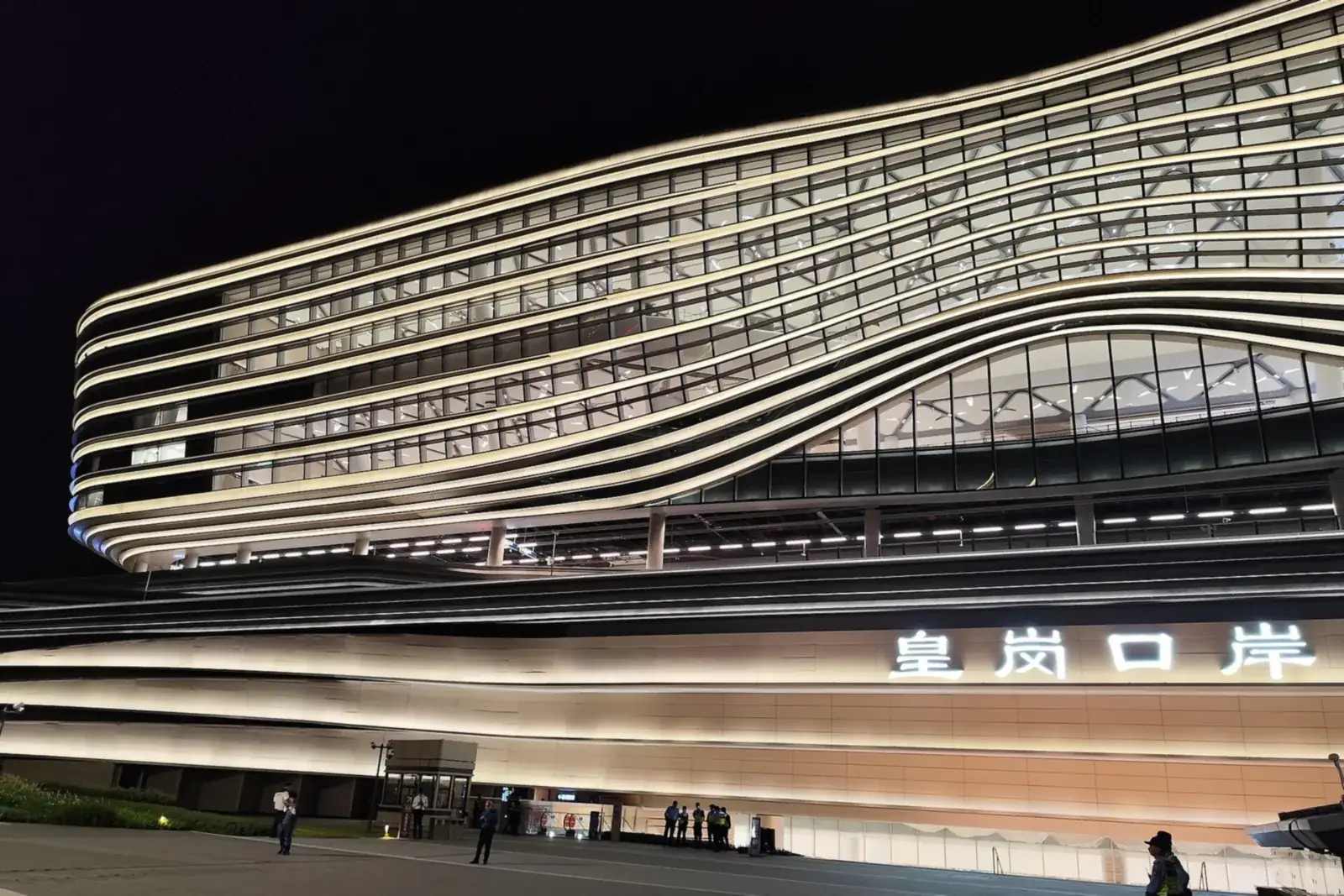
In a written reply to the Legislative Council on 4 November, the Secretary for Security confirmed that the Hong Kong side of the new Huanggang Port is a closed area and that “No pick-up and drop-off areas are provided for private cars (including ride-hailing vehicles to be issued with permits in future) within the HKPA.” So a relative can’t simply drive your parents or children to the port door. With seniors, children and luggage, the real choices are a bus or minibus, a taxi, or a cross-border car that stays with you through the crossing. To start from your own front door, book a Hong Kong to Shenzhen private car transfer; we confirm the crossing for your trip when you book.
What the LegCo reply says
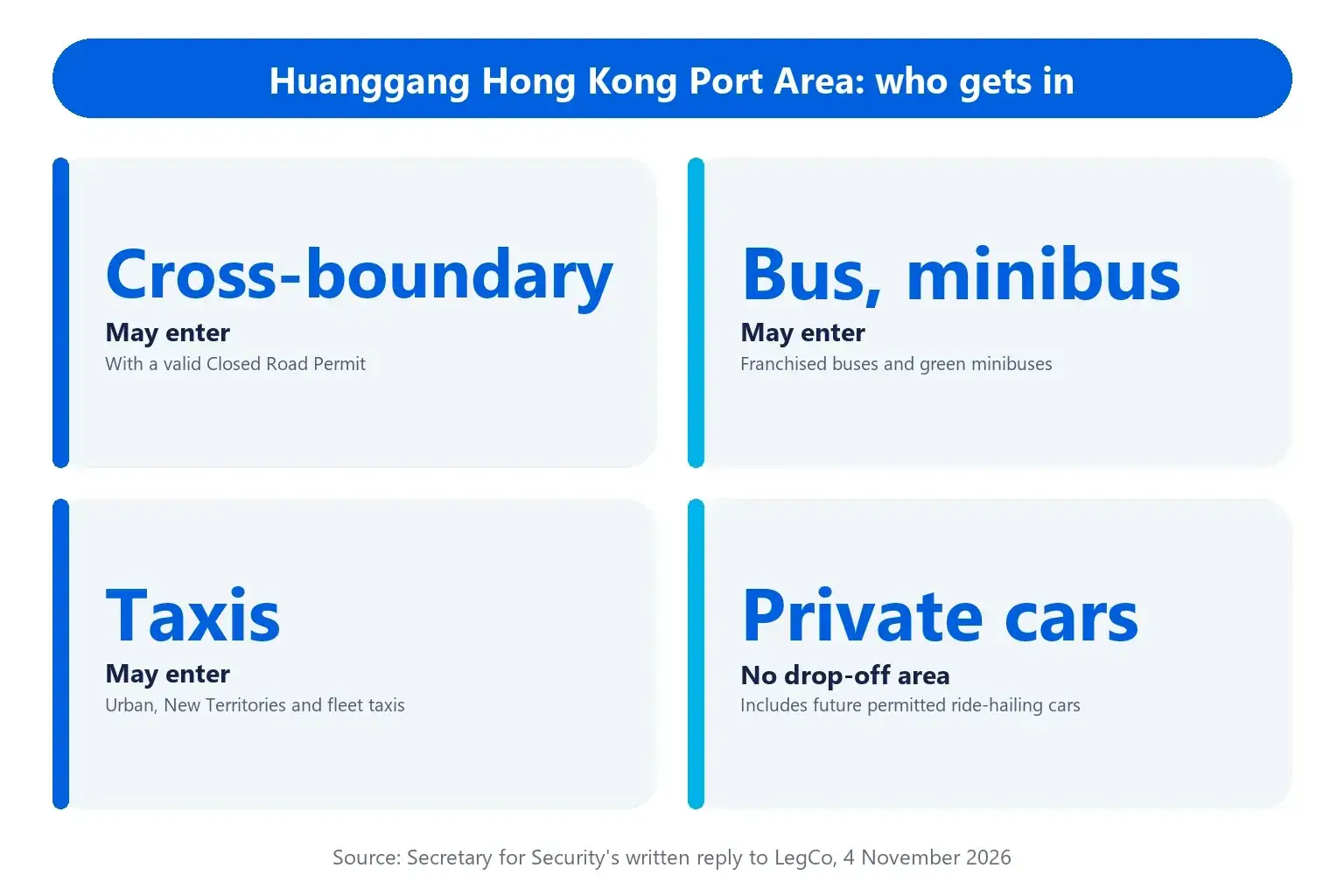
As of 6 November 2026, this reply is the government’s account of the port’s first month. The parts that matter for getting there:
| Vehicle | What the reply says |
|---|---|
| Cross-boundary vehicles | May enter with a valid Closed Road Permit |
| Franchised buses, green minibuses | Designated public transport; may enter |
| Taxis | Urban, New Territories and fleet taxis may enter |
| Private cars | No pick-up or drop-off area, including future permitted ride-hailing cars |
The reply calls this the most effective use of the limited space in the port area, and says the same closed-area approach applied at the old Lok Ma Chau Control Point and applies at other land control points. A legislator asked whether land had been reserved for ride-hailing bays. The reply didn’t answer that directly; it said the Transport Department will keep watching operations and passenger demand. The Security Bureau’s transport page adds that the port has no public car park because of limited space.
The port is open 24 hours, according to the Immigration Department. As of 6 November 2026, the reply puts average daily crossings at over 86,000 on weekdays and close to 140,000 on weekends and holidays, so it’s worth planning how you’ll get there even outside the obvious peaks.
How seniors, children and luggage reach the port
| Option | What official sources say | With seniors or children |
|---|---|---|
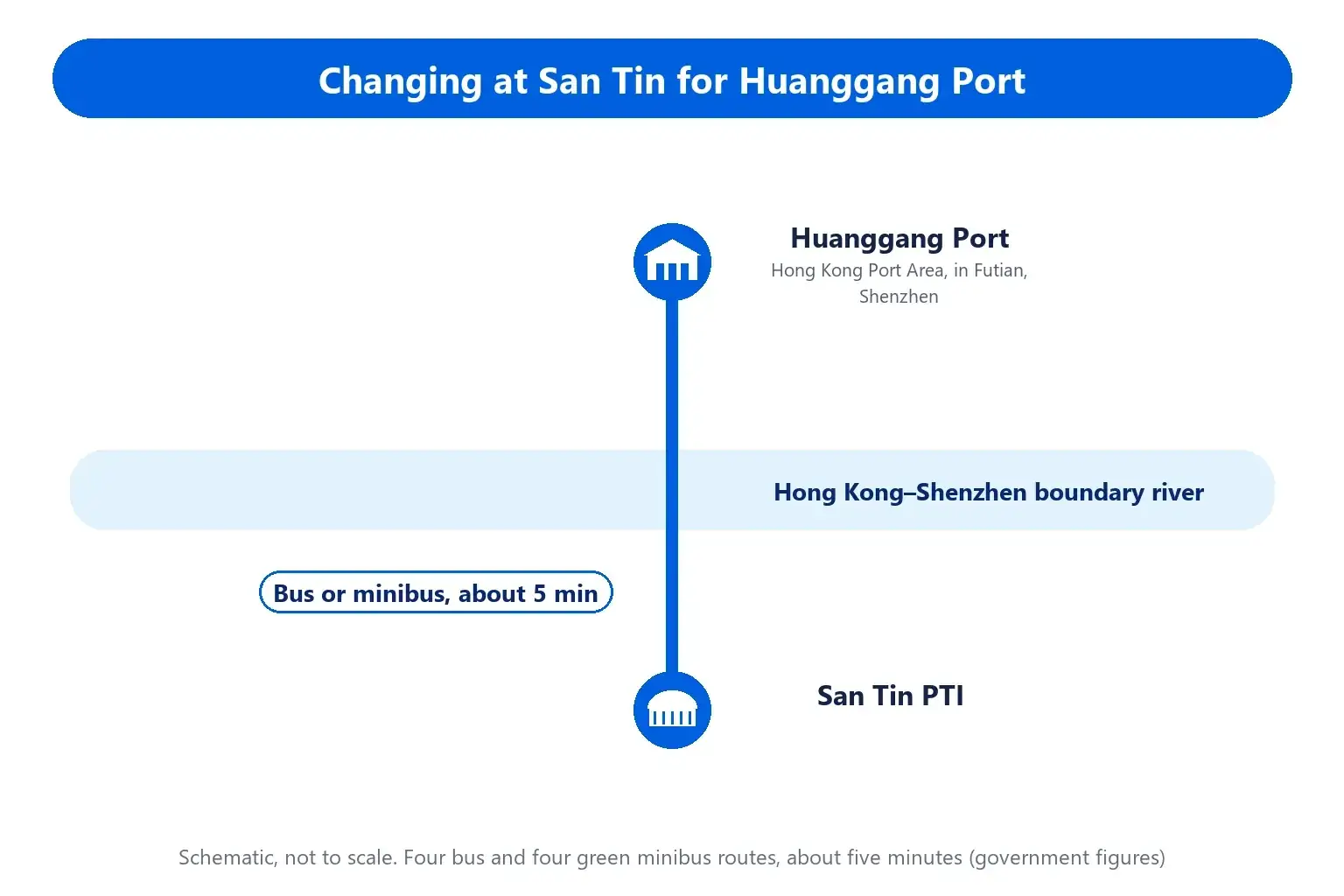
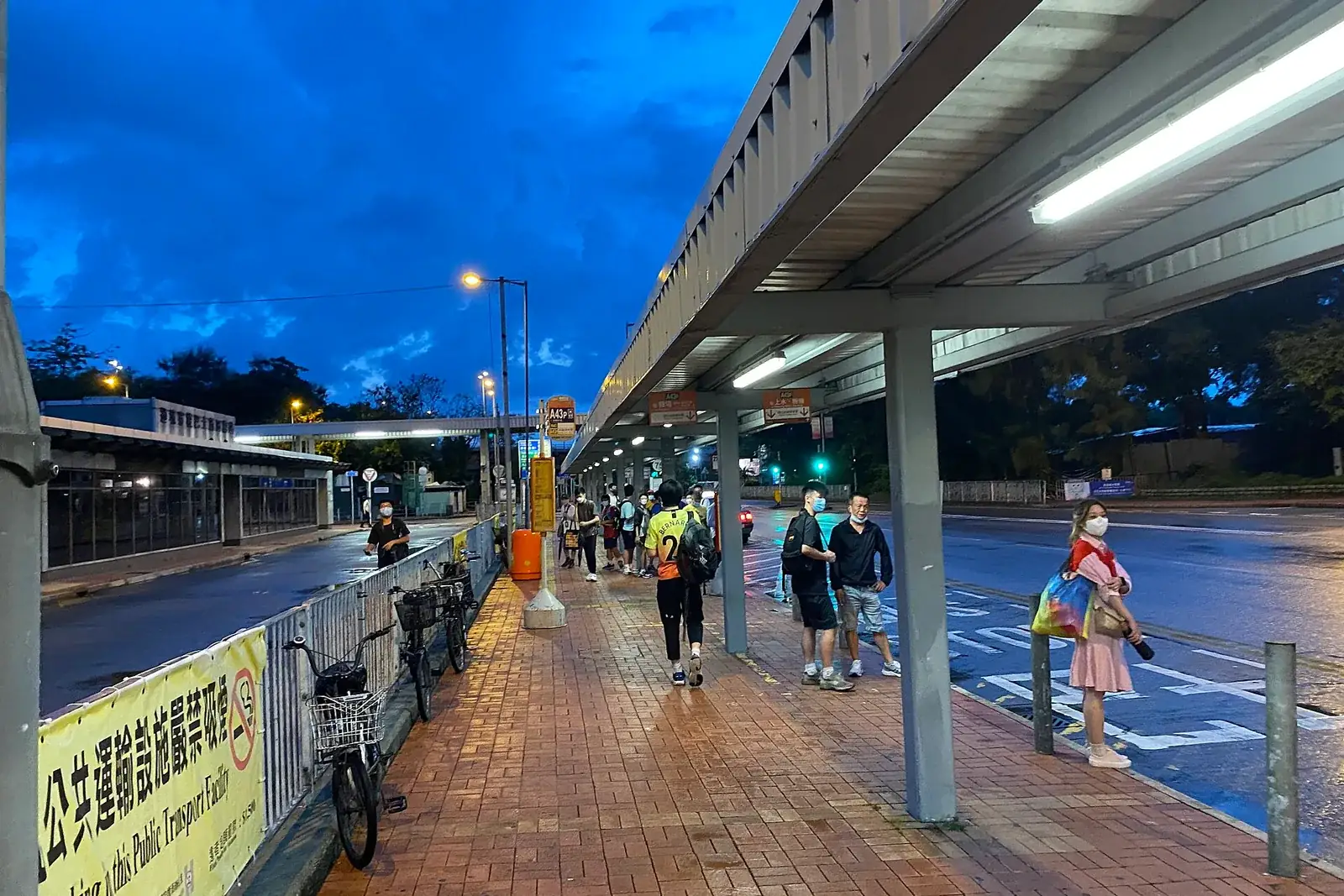
| Bus or minibus via San Tin | Four franchised bus routes and four green minibus routes (three daytime and one overnight of each) link the port and San Tin Public Transport Interchange in about five minutes | It’s a change of vehicle. San Tin has an air-conditioned waiting area, and the Transport Department has asked operators to deploy more buses with luggage racks |
| Taxi | May enter; red and green taxi stands and fleet taxi stopping places at the interchange | No stopping place for pre-booked non-fleet taxis, and you need onward transport in Shenzhen |
| Cross-boundary vehicle | May enter with a valid Closed Road Permit; the Security Bureau also lists cross-boundary hire car services | One car for the whole trip, though passengers generally still get out to clear |
| Ordinary private car | No drop-off area in the port area and no public car park | Can’t take you into the port area. The reply doesn’t say how private cars should use San Tin, so follow the signs on site |
For a family going from a Hong Kong home to a Shenzhen address, the point of a private chauffeur service here is simple: you don’t change at San Tin, and you don’t need another vehicle on the Shenzhen side. At Huanggang, passengers generally still get out with all their luggage to clear, and after the crossing the same driver carries on to your destination.
How a cross-border car clears Huanggang
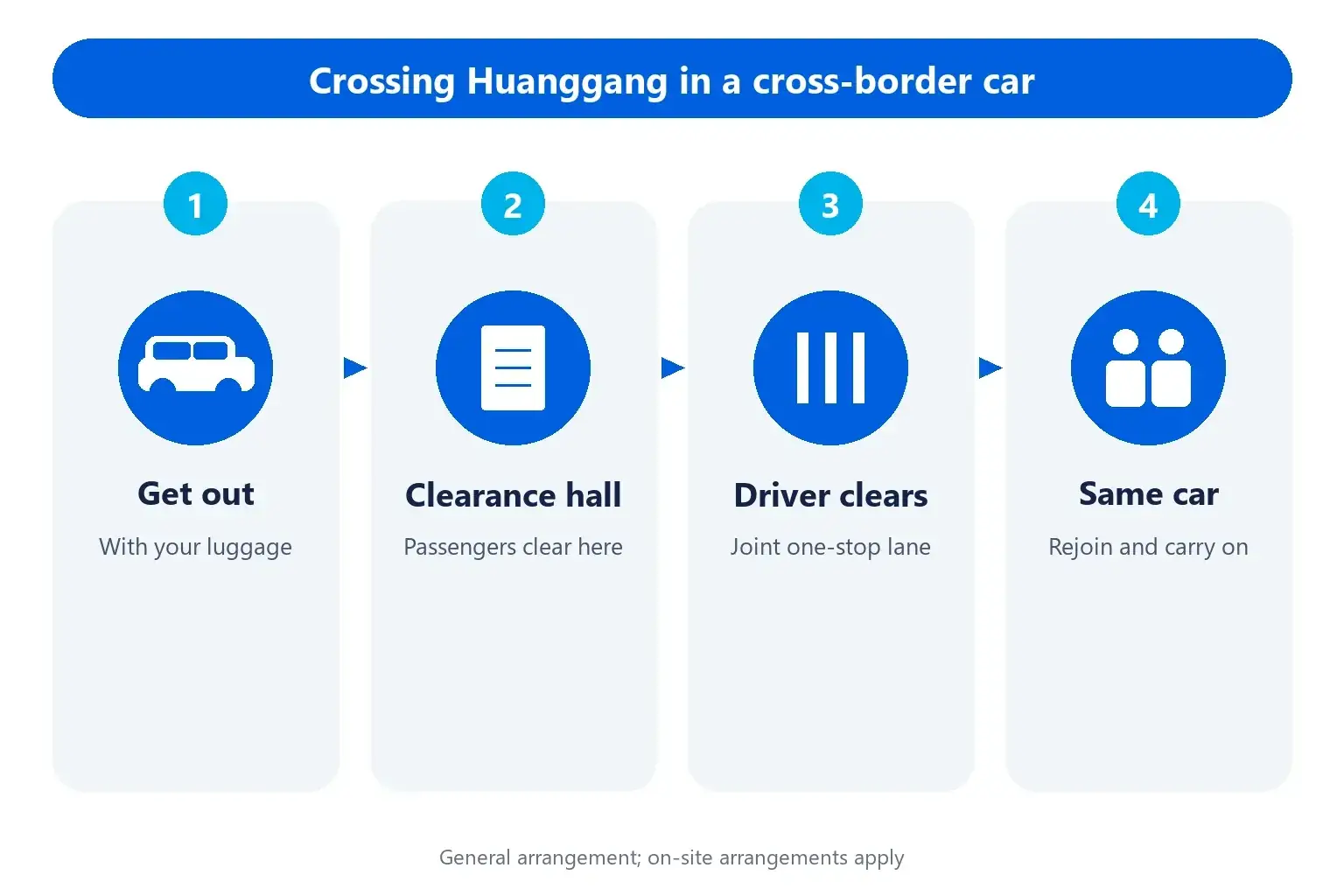
New Huanggang separates passenger and vehicle checks. The Security Bureau says cross-boundary passengers generally need to get out. Private car passengers go to the immigration clearance hall for on-board passengers, while the driver takes the car into the joint one-stop lane. The usual steps are:
- Get out. The car reaches the drop-off area and passengers take their luggage with them.
- Clear. Passengers complete both sides’ formalities in the clearance hall.
- Driver clears. The driver goes through the joint one-stop lane.
- Rejoin. Passengers get back into the same car and carry on.
This is one step in how a cross-boundary vehicle clears the port. Passengers rejoin the same car afterwards, so it isn’t a place to be dropped off and left, or a general stopping place. We have no access beyond other cross-boundary vehicles, and we don’t offer casual pick-ups or drop-offs at the port. On-site arrangements apply.
Who can stay in the car? People aged 70 or over, children under 7, pregnant women and people with disabilities or limited mobility from illness, injury or surgery are reported to be able to stay in the car; the port’s arrangements on the day apply. Tell us about your party when you book. Other family members generally still get out.
Will your trip use Huanggang at all? As of 6 November 2026, the government says cross-boundary private cars with permits for other land crossings (Shenzhen Bay, Man Kam To, Sha Tau Kok and Heung Yuen Wai) are permitted to use Huanggang between midnight and 6:30 am. So not every cross-boundary car uses Huanggang through the day, and the crossing depends on the trip and the vehicle. Shenzhen Bay works differently: documents are usually checked in the car on the Hong Kong side, and passengers walk through on the Shenzhen side, where the driver picks them up.
Once you’re inside
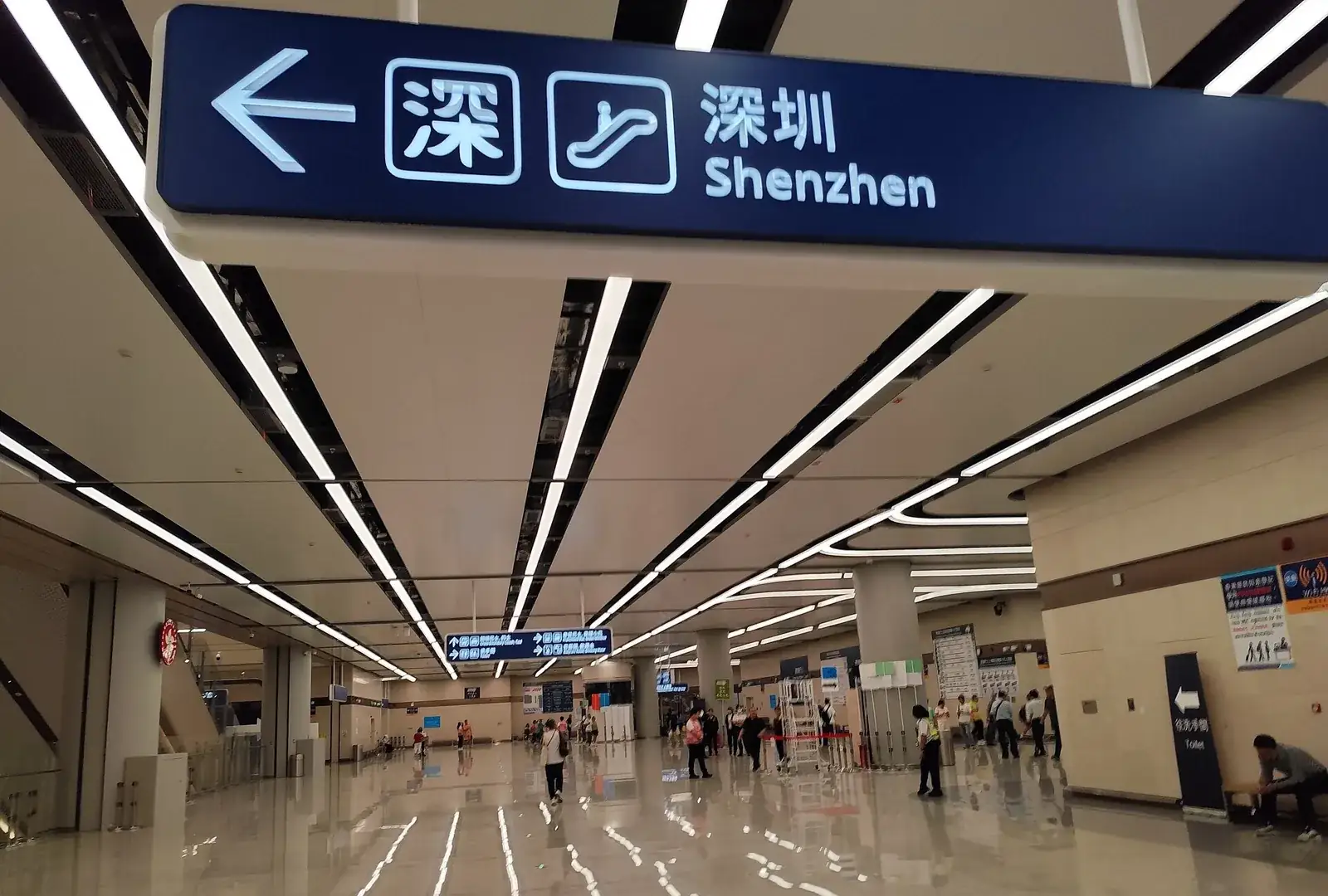
The reply also notes that some travellers weren’t familiar with the new mode, for example because they hadn’t registered in advance.
- Children. The Immigration Department reminds parents and legal guardians to register children aged 7 to 17 in advance.
- e-Channel registration. A registration desk has been added outside the departure hall on the 5th floor of the port building.
- Not registered? Travellers who aren’t eligible or haven’t registered are directed to the traditional counters.
- Queues. The reply says waits at the automated channels are no more than five minutes most of the time, and average under 15 minutes at peak.
For more on travelling with family, see crossing to Shenzhen with elderly parents and kids. For late-night crossings, see getting back to Shenzhen late at night.
Riding with us
- Passengers. A 7-seater takes up to 6 passengers; 7 to 8 people means two cars.
- Luggage. A 7-seater takes four 28-inch cases plus two cabin bags, personal luggage only.
- Price. One fixed price per car, the same for 1 to 6 passengers; the route page shows it.
- Drivers. Our drivers speak Cantonese and Mandarin, and every car carries dual plates and passenger insurance.
- Night. 01:00–08:00 night service: urgent trips only.
For the crossing itself, see Huanggang Port by car and crossing the border by car.
Before you go
- Register children aged 7 to 17 in advance
- Every passenger brings their own travel document
- Keep luggage together so it can all come with you when you get out
- Book a Hong Kong to Shenzhen private car transfer with your group size, the ages of any seniors and children, luggage, and pick-up and drop-off addresses
How CROSSBAY can help
| Route | Crossing | 7-seater, one way, from |
|---|---|---|
| Hong Kong ⇄ Shenzhenapprox. 1 – 1.5 hrs | Shenzhen Bay / Huanggang / Liantang | HK$825 |
- One fixed price for the whole car, the same for one passenger or six, with no meter and nothing extra for traffic.
- Tolls, border and parking fees, fuel and the driver are included.
- Border queues and official checks never count as waiting; if you walk through the hall, the driver waits at the exit with 45 minutes free.
Starting fares for a 7-seat Alphard / Vellfire; other cars, night trips and extras are in the service rules. Your written confirmation sets the final price.
Questions
Can a family member drive me to Huanggang Port in a private car?
Not into the port area. The Secretary for Security told LegCo on 4 November 2026 that the Hong Kong Port Area is a closed area, open only to cross-boundary vehicles with valid Closed Road Permits and designated public transport. He added that no pick-up and drop-off areas are provided there for private cars, including ride-hailing vehicles to be issued with permits in future. The Security Bureau says the port has no public car park.
Can a taxi go to Huanggang Port?
Yes. The reply lists urban, New Territories and fleet taxis among the vehicles that may enter. The Security Bureau's transport page says the interchange has red and green taxi stands and stopping places for fleet taxis, but no stopping place for pre-booked non-fleet taxis.
Do seniors and children have to get out of a cross-border car at Huanggang?
Passengers in cross-boundary vehicles generally get out. People aged 70 or over, children under 7, pregnant women and people with disabilities or limited mobility from illness, injury or surgery are reported to be able to stay in the car; the port's arrangements on the day apply. Tell us about your party when you book.
Do your cars have a special pick-up or drop-off arrangement at the port?
No. The reply says cross-boundary vehicles with valid Closed Road Permits may enter the port area, and we don't offer casual pick-ups or drop-offs at the port. We have no access beyond other cross-boundary vehicles. A cross-border car simply means one car for the whole trip, clearing under the usual separate passenger and vehicle checks. We confirm the crossing for your trip when you book.
References
- LCQ14: Operation of new Huanggang PortHKSAR Government press release (written reply by the Secretary for Security) · 2026-11-04
- Huanggang Port transport informationSecurity Bureau · viewed 2026-11-06
- Huanggang Port introductionSecurity Bureau · viewed 2026-11-06
- Huanggang Port clearance modeSecurity Bureau · viewed 2026-11-06
- Control pointsImmigration Department · viewed 2026-11-06
- CS chairs interdepartmental working group meeting on Huanggang Port Hong Kong Port AreaHKSAR Government press release · 2026-10-28
- 新皇崗口岸|10.12開通 舊口岸清晨6時半正式「截龍」 (New Huanggang Port opens 12 October)Sing Tao Headline · 2026-10-09
Border arrangements, timetables and rules can change at short notice; check the latest official notices before you travel. Spotted an error? Tell us
Image credits
- Cover: New Huanggang Port at nightGUSOANHEA ZZ LOOAKM (Wikimedia Commons) · CC0
- The hall in the Hong Kong portion of the new Huanggang PortKingHill Mount Z (Wikimedia Commons) · CC0
- San Tin Public Transport Interchange bus stopLN9267 (Wikimedia Commons) · CC BY-SA 4.0
- 3 illustrations (who may enter the port area, the clearance steps, changing at San Tin)CROSSBAY editorial team · Illustration drawn with a graphics program