
Hong Kong’s Centre for Health Protection said on 30 October that Guangdong recorded 1,753 chikungunya cases this year to September, 1,014 of them in September. On 1 November Macau’s Health Bureau said it would carry out mosquito control near the Venetian after a confirmed case who had visited Macau. If you’re heading north or to Macau by cross-border car, here is what the officials advise. This page only summarises what the CHP and Macau’s Health Bureau have published; it isn’t medical advice, so ask a doctor if in doubt. For Macau, see our Hong Kong to Macau private car transfer; for Shenzhen, a Hong Kong to Shenzhen private car transfer.
The latest figures
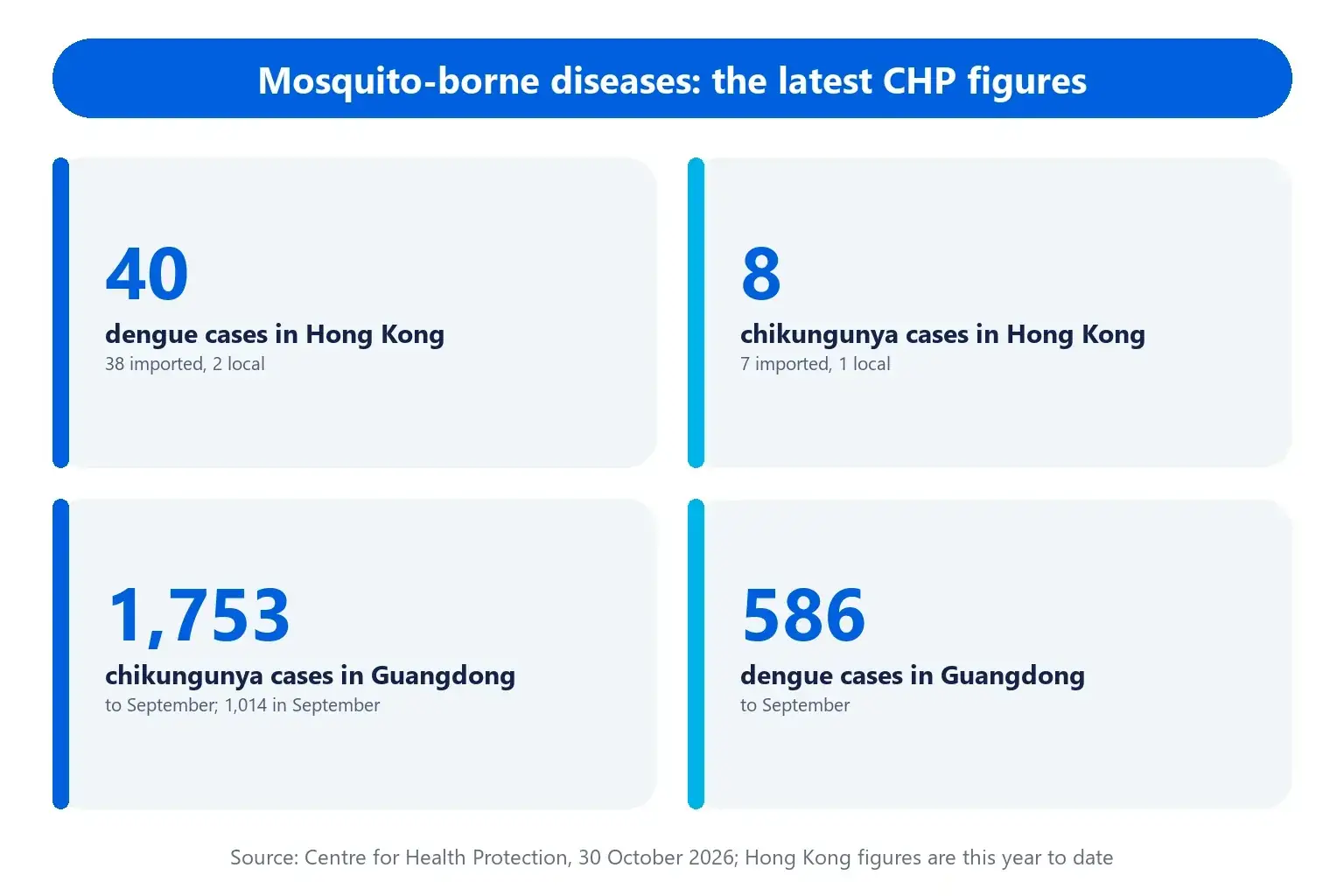
As of 2 November 2026, the CHP’s 30 October update says:
| Where | Disease | Cases |
|---|---|---|
| Hong Kong (this year) | Chikungunya | 8 (7 imported, 1 local) |
| Hong Kong (this year) | Dengue | 40 (38 imported, 2 local) |
| Guangdong (to September) | Chikungunya | 1,753, of which 1,014 in September |
| Guangdong (to September) | Dengue | 586 |
- New case. From 23 to 29 October Hong Kong recorded one imported chikungunya case: a 44-year-old woman who had visited the Chinese Mainland during the incubation period.
- Guangdong’s trend. The CHP says September’s chikungunya cases in Guangdong rose sharply compared with July and August.
Macau’s notice of 1 November
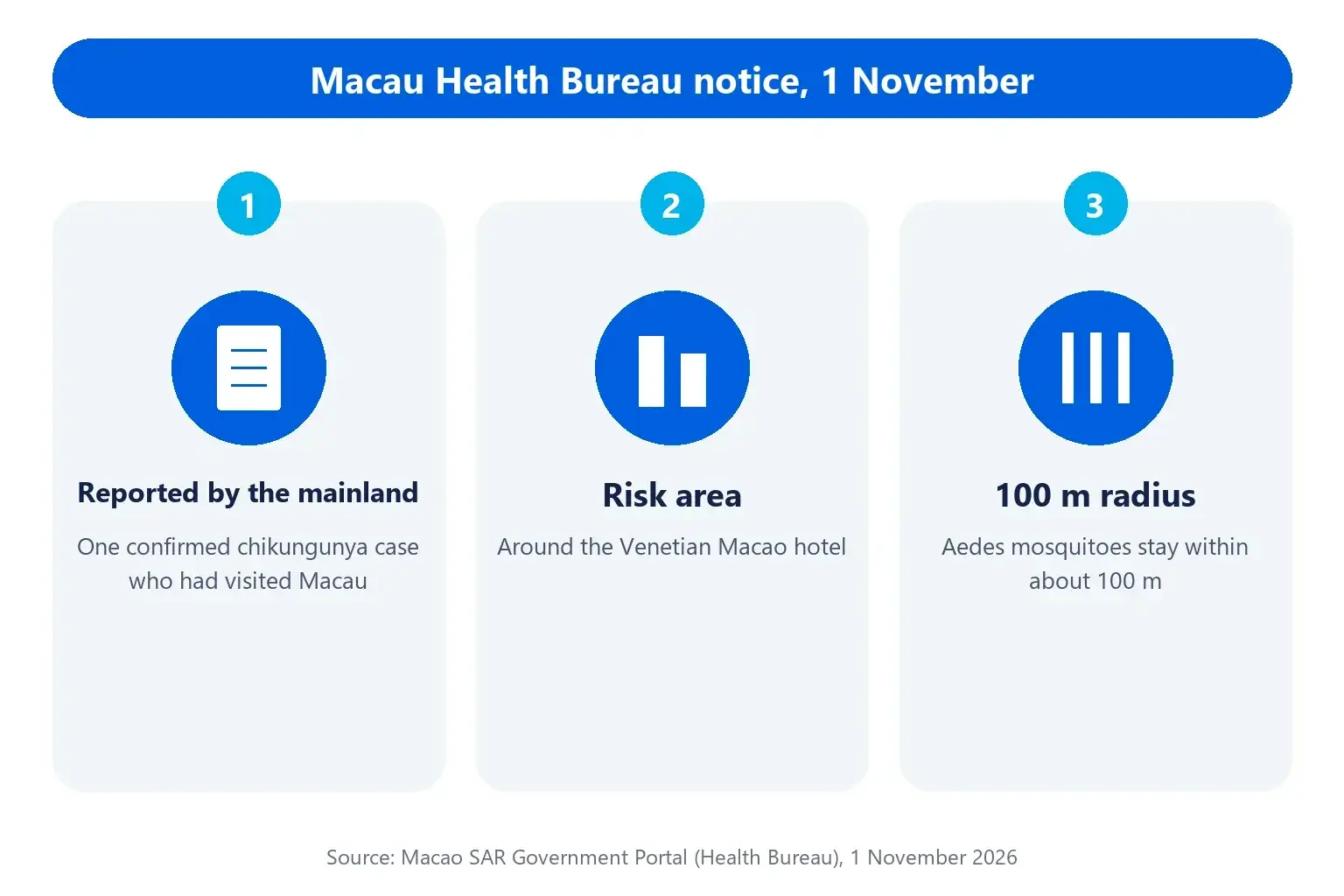
Macau’s Health Bureau said on 1 November 2026:
- The case. The mainland notified the bureau of one confirmed chikungunya case who had visited Macau.
- The area. Over the following days the bureau will carry out mosquito control, with the managers of the premises concerned, in the risk area near the Venetian Macao hotel.
- The radius. Aedes mosquitoes stay within about 100 metres of where they breed, so the area is a 100-metre radius.
- The reminder. The bureau asks residents to note the arrangements and take preventive measures together.
What the CHP advises
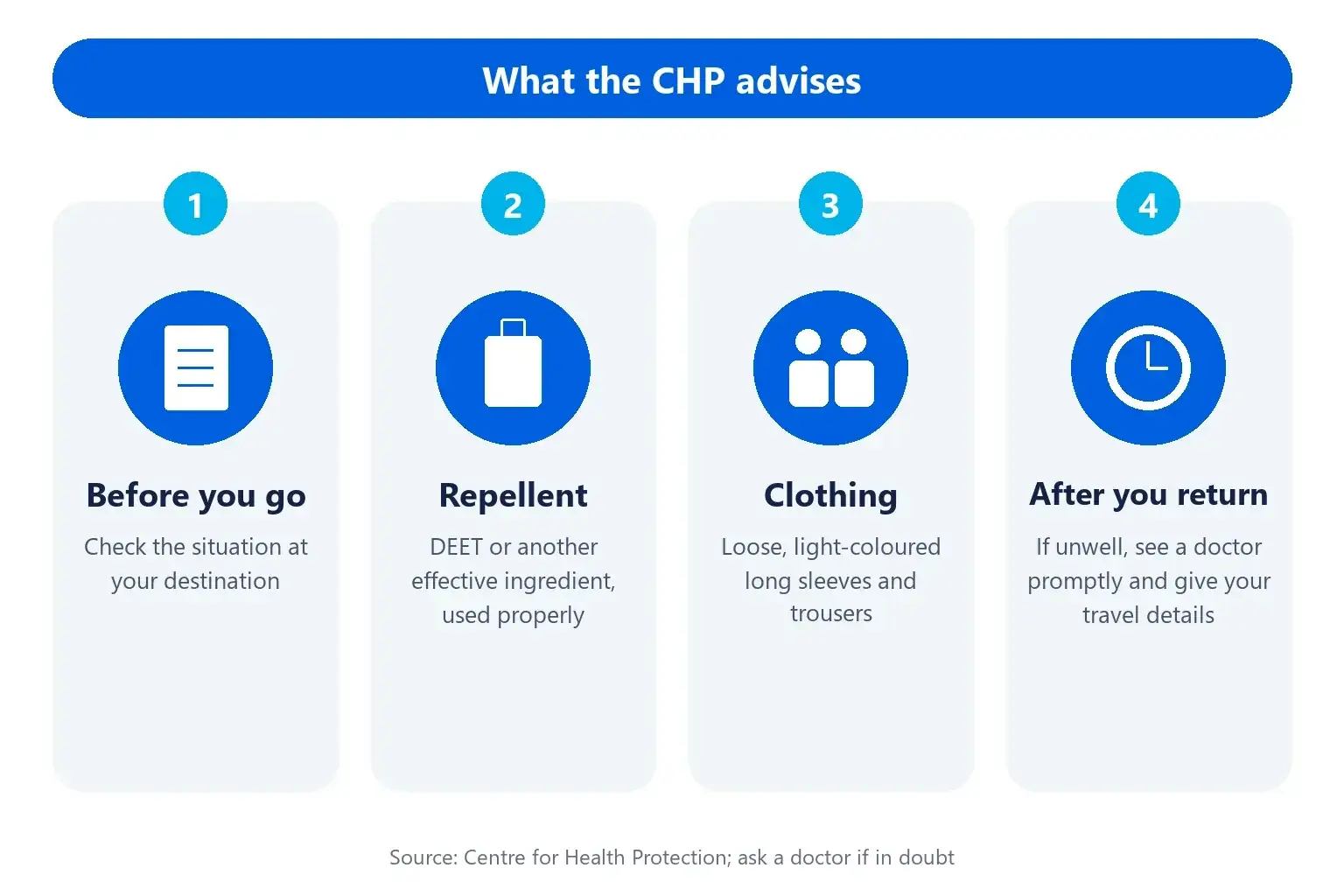
In the CHP’s words:
- Before you go. “Members of the public should check the situation at their destinations before travelling”.
- Repellent. “Whether travelling or not, members of the public should use DEET-containing insect repellents or other effective active ingredients properly to prevent mosquito bites”. Read the label first and apply it to exposed skin and clothing.
- Clothing. “Wear loose, light-coloured, long-sleeved tops and trousers”.
- After you return. Travellers returning from affected areas “should apply insect repellent for at least 14 days after arrival”; if they feel unwell, for example with a fever, they “should seek medical advice promptly, and provide travel details to the doctor”.
- Children and pregnant women. There are limits on DEET concentration; see the CHP’s chikungunya page and tips for using insect repellents.
Before you ride with us
- Documents. Home Return Permit, Hong Kong ID card or other travel documents.
- Luggage. A 7-seater takes four 28-inch cases plus two cabin bags.
- Group size. Each 7-seater takes up to 6 passengers; 7 or 8 people need two cars.
- Drivers. Our drivers speak Cantonese and Mandarin.
Before you go
- Check the latest notices from the CHP and the health authority where you’re going
- Pack repellent and light-coloured long sleeves
- Book a Hong Kong to Macau private car transfer or a Hong Kong to Shenzhen private car transfer
Travelling north with children? See Kids to Guangzhou in flu season by cross-border car. For more on crossing, see crossing the border by car.
How CROSSBAY can help
| Route | Crossing | 7-seater, one way, from |
|---|---|---|
| Hong Kong ⇄ Macauapprox. 1 – 1.5 hrs | Hong Kong–Zhuhai–Macau Bridge | HK$1,848 |
| Hong Kong ⇄ Shenzhenapprox. 1 – 1.5 hrs | Shenzhen Bay / Huanggang / Liantang | HK$825 |
- One fixed price for the whole car, the same for one passenger or six, with no meter and nothing extra for traffic.
- Tolls, border and parking fees, fuel and the driver are included.
- Border queues and official checks never count as waiting; if you walk through the hall, the driver waits at the exit with 45 minutes free.
Starting fares for a 7-seat Alphard / Vellfire; other cars, night trips and extras are in the service rules. Your written confirmation sets the final price.
Questions
How many chikungunya and dengue cases has Hong Kong had this year?
The Centre for Health Protection said on 30 October that Hong Kong has recorded 8 chikungunya cases this year (7 imported, 1 local) and 40 dengue cases (38 imported, 2 local).
What is the situation in Guangdong?
Citing the Guangdong Provincial Disease Control and Prevention Administration, the CHP said Guangdong recorded 1,753 chikungunya cases this year to September, 1,014 of them in September, and 586 dengue cases.
What happened in Macau on 1 November?
Macau's Health Bureau said that on 1 November the mainland notified it of a confirmed chikungunya case who had visited Macau. The bureau said it would carry out mosquito control in a 100-metre-radius risk area near the Venetian Macao hotel in the coming days.
What does the CHP advise?
The CHP advises checking the situation at your destination before travelling; whether travelling or not, using DEET-containing insect repellents or other effective active ingredients properly; wearing loose, light-coloured, long-sleeved tops and trousers; and, after returning from affected areas, seeking medical advice promptly if you feel unwell, for example with a fever, and giving the doctor your travel details.
References
- Update on mosquito-borne diseases, dengue fever and chikungunya feverHKSAR Government press release (Centre for Health Protection) · 2026-10-30
- 衛生局滅蚊通知 (Health Bureau mosquito control notice)Macao SAR Government Portal (Health Bureau) · 2026-11-01
- Chikungunya FeverCentre for Health Protection · viewed 2026-11-02
- Tips for using insect repellentsCentre for Health Protection · viewed 2026-11-02
- Chikungunya FeverDepartment of Health Travel Health Service · viewed 2026-11-02
Border arrangements, timetables and rules can change at short notice; check the latest official notices before you travel. Spotted an error? Tell us
Image credits
- Cover: Taipa Houses, MacauLN9267 (Wikimedia Commons) · CC BY-SA 4.0
- Aedes albopictus mosquitoSixto Emmanuel Picones Puebla (Wikimedia Commons) · CC BY-SA 4.0
- Cotai Strip, MacauSeader (Wikimedia Commons) · CC0
- 3 illustrations (the latest figures, the CHP's advice, Macau's mosquito control notice)CROSSBAY editorial team · Illustration drawn with a graphics program